threads of freeorder, leif smith, editor — Subscribe
Each separate month of Threads: leifsmith.substack.com
7
8 am 14 Aug 2026 (draft) - threads of freeorder
 
This substack is becoming notes on conversations — that’s why the draft of the coming issue is always made available. If you have not emailed me before (and gotten a reply) please use this address: leifsmith+1@gmail.com — to circumvent spam guards :-) — or txt 720-891-7308
 
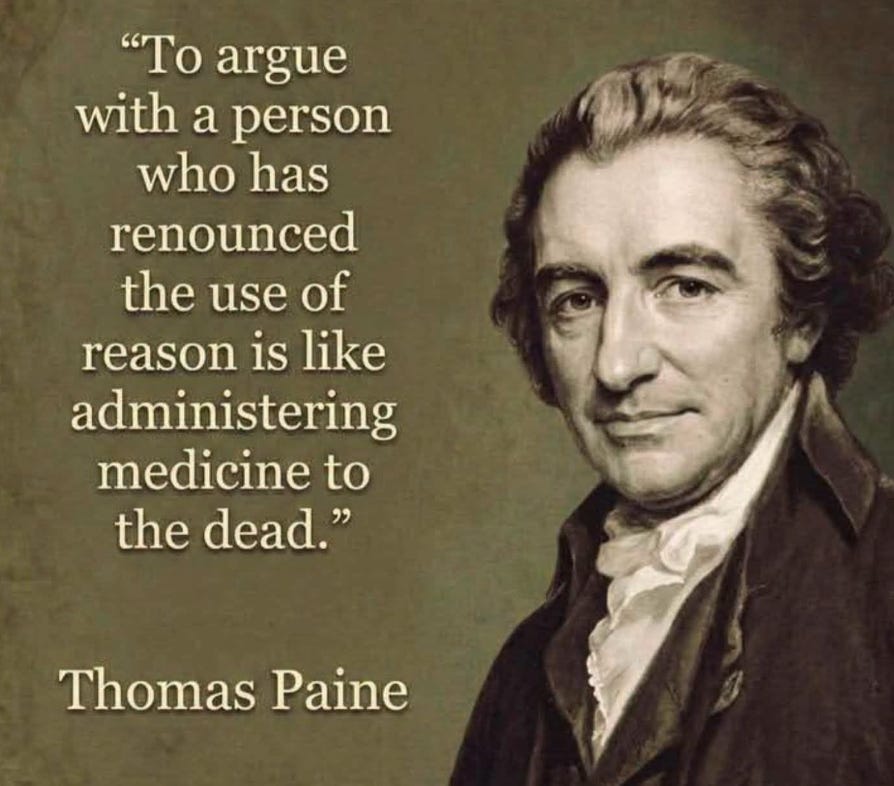
Medicine-to-Dead_Thomas_Paine
posted by Robert W. Malone on his weekly collection of cartoons
🌱 freeorder (process) —> Freeorder (outcomes)
 
*
 
V
Healthspan Action Coalition (HSAC) ••• Overview •••
*
Gayle Pergamit ••• and her Agua Via ••• colleagues now make up the Environmental Advisory Board of HSAC — see their Leadership page (about 50% down).
*
 
V
Iran: Mahyar Tousi, a recent refugee from the U.K. now broadcasting from a Tousi.TV studio in Florida, is an essential source of information and insight, especially about Iran.
*
Tousi’s daily program ••• in close alignment with Freeorder (he does not use the word)
*
 
*
 
V
Sarah Paine (24 years at Naval War College)
V
“Why Putin and Xi can't escape geography” •••
*
‘In this lecture, military historian Sarah Paine lays out the geopolitical framework that has shaped global power for two thousand years: the divide between continental empires that pursue security through territorial conquest (China, Russia) and maritime powers that pursue prosperity through trade (Britain, the US). Recorded first in Paine's 2025 series, this is the framework that all her other lectures build on.’
*
China is favoring the “Recently Xi Jinping has been privileging the crony sector over the private sector” — have seen it, but never heard that simple description before! Crony capitalism, yes; but crony sector, no. A lesson in effective naming.
*
 
V
Pavel Durov - talks
*
 
V
Transaction Privacy, Governability, and Trust - in Distributed Ledger systems
V
Carl Mikael Björn ••• comments on “Nothing to see here” ••• a post on Hedera’s “The Consensus” ••• LinkedIn
*
‘What stood out to me is that transaction privacy solves a very specific problem. It determines who can see information. Institutions also need to understand how commitments come into existence. Over the years, I’ve found that the difficult questions rarely appear after settlement. They appear beforehand. Who had the authority to initiate the transaction? What conditions had to be satisfied? What assumptions was the decision based on? If those assumptions changed, who could still intervene before the transaction became irreversible? That was one of the observations that led me to develop Governable Trust Architecture. Cryptography can protect confidentiality exceptionally well. Governability is about preserving an organisation’s ability to understand, direct and intervene as decisions emerge across people, software, institutions and increasingly autonomous systems. I don’t see these as competing ideas. They solve different problems. Privacy protects information. Governability protects an institution’s ability to exercise authority over the commitments it makes. I suspect both will become increasingly important as tokenised financial infrastructure moves into mainstream institutional use.’
*
 
V
What’s Not Broken — title of a book that should exist
V
Key question: Why is X not broken? Example:
V
Why is Interstate-70 open through Glenwood Canyon?
*
The Glenwood Recovery Series, Colorado Department of Transportation (CDOT)
*
Some say “Government produces nothing.” Watch and see what you think.
*
The above example happens to be about a government provided service, but this question applies to everything.
*
Take any simple thing you depend on without giving it thought, and ask “Why is this not broken?” Trace the chain of things that must happen if that thing is to keep working. When I do this, the astonishment never ends.
*
 
V
A note to readers of this draft
*
I may put diverse things in this draft, as fuel for discussion, but remove most of it before publishing at the end of each month.
*
 
*
Perspective on the Emergence of Freeorder (always in progress)
*
 
V
Milton Friedman, Two Videos:
*
Free to Choose
*
The Power of Choice: The Life and Ideas of Milton Friedman
*
 
*
The Autobiography of a Revolutionary, by Peter Kropotkin
V
Lenin’s Mistress: The Life of Inessa Armand
*
Had I titled this book it would have properly honored Armand, by using the word Comrade rather than Mistress. Her intelligence, vision, ability to inspire and organize, and artistic sensibility were all of high order. She was perhaps the most powerful woman in revolutionary Russia. “Mistress” might sell books but it fails in every other way.
V
Ludwig von Mises
*
[]Gave Hayek the foundation of economic understanding to allow him to resist the overwhelming forces advocating compulsory organization of society by experts that dominated Britain, and Europe in the 1930s.
V
Hayek: A Life, 1899-1950, by Bruce Caldwell and Hansjorge Klausinger
*
[]Reference the chapter recording Hayek’s resistance to the tides of his times.
V
Beatrice Webb, Our Partnership
*
[]the ideal of the London School of Economics
V
Anthony Fisher, Champion of Liberty
*
[]F. A. Harper sends Tony to Cornell to learn advanced chicken farming. This simple act laid the foundation to create the capital to found the Institute of Economic Studies in London.
*
 
*
A Turning Point? Bill Maher’s “Real Time”, Friday, August 31, 2026: “New Rule: Commie By Your Name | Real Time with Bill Maher (HBO)” •••
*
 
V
How To Determine The Risks and Benefits of Each Vaccine••• A Midwestern Doctor
*
Knowing how vaccines work is necessary for understanding which ones are likely to help, which ones are likely to harm, and the forgotten alternatives to immunization they medical industry buried.
V
A Midwestern Doctor summarizes his article:
*
The vaccine industry has largely escaped scrutiny because of the belief that “vaccines are safe and effective”—a slogan that treats every vaccine as an identical good and discourages any examination of how vaccines are actually made or how sharply their individual risks and benefits differ.
Here I will review the foundational principles of vaccine design and the clinical implications that I believe are essential for understanding why these products so often fail to live up to their promises and have major safety issues.
Building upon this, I will show how the actual risks and benefits of a vaccine can be calculated (something medicine almost never computes) and why many commonly administered ones rest on very shaky ground that makes it hard to ever justify giving them to anyone.
I will also review numerous core principles of immunology that virtually never enter the vaccine discussion and help to explain why vaccines cause so many different immunological issues.
With this framework, I will provide a guide to assist you in determining the risks and benefit of each vaccine on the CDC schedule and tools for identifying the most toxic and unnecessary ones.
Medicine’s religious focus on vaccines has covered up the fact many safe natural alternatives to vaccines exist which can prevent a variety of complex illnesses. Likewise, much in the same way a few vaccines have been used to treat challenging chronic conditions (e.g., cancer, diabetes, shingles, fibromyalgia), forgotten natural therapies have been as well that both eliminate chronic debilitating illnesses, and provide completely safe methods to make populations immune to problematic infectious diseases.
*
 
*
Markets Permit the Competitive Distribution of Risk
 
.oOo.