threads of freeorder, leif smith, editor — Subscribe
Each separate month of Threads: leifsmith.substack.com
 
October 2026 - threads of freeorder
 
wizards_1
Cast from a foxglove by David Hock
🌱 freeorder (process) —> Freeorder (outcomes)
 
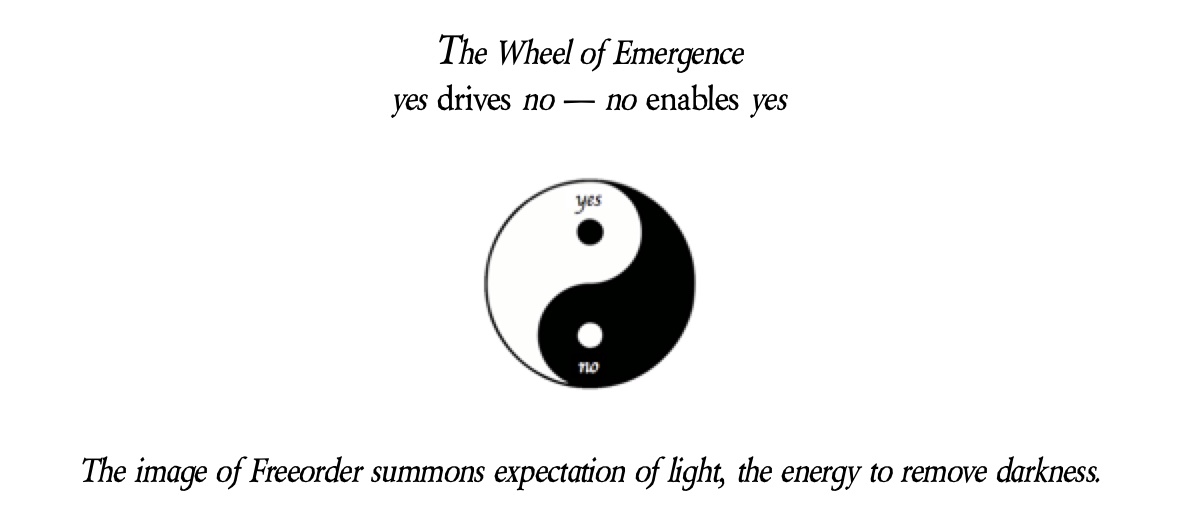
This substack is about the Emergence of Freeorder, a process through which explorers of many kinds make a world that tolerates their questions and ventures, while at the same time they learn to live well in such a world and acquire the wisdom not to destroy it. To these ends not only is “yes” essential, but also “no”.
 
Wheel-of-Emergence
 
Thomas Sowell’s new website: tsfreemind.com
Emil Hasle writes: ’96-year-old Thomas Sowell is now working on a simple website to help educate young people on how to confront indoctrination and totalitarian beliefs and test them against facts and logic.
‘His website features extensive research on 32 topics covering various issues, by himself and like-minded philosophers.’
Thomas Sowell: Facts Against Rhetoric: Purpose And Urgency
 
The basis of the freeorder network - the unfoldment of potentials
Millions of silent listening posts, such as the Office for Open Network, Denver, 1975-2000. Physical presence is not necessary, but at least intermittent manifestation is a very good thing. The analog is precious in a world of digital avalanche.
Listening for what?
For adventures, for sparks of adventures, for explorations that can be spun into fabrics of stories that tell of life from seed to flower.
Why?
Because the unfoldment of potentials matters and delights us.
Larkspur-aspiration-small
The Emergence of Freeorder (path, symbology, architecture)
freeorder (process, internal & external) —> Freeorder (social outcome).
Path: Diaspora —> Concentration —> Emergence …
As the honest exile themselves from failing, dishonest, structures of relationships (institutions) they find each other and begin to build new ventures committed to truth. Forges of every type catalyze and accelerate this process.
At all points the process needs catalysts and accelerants — a job for thousands of independent, increasingly networked, ∮forge.
Symbology for the architecture of the Emergence of Freeorder
At the heart of the Emergence are millions of ⦰forge (silent forges) made possible by the investments of ∮forge; and, in many cases, by investments in ⥮forge (aligning forges).
Kinds of Forge (FreeORderGEnerator): All essential for the Emergence: ∅forge, ⥮forge, ∮forge
∅ Silent — ∅forge
Operating within a space indicated and held constant by a only a few words: quest, mutual aid, honesty, truth, spontaneous order, design, emergent order. Understanding freeorder happens through use of tools and ways of doing, not by words.
⥮ Aligning (aligned beyond agreement) — ⥮forge
The archipelago of freeorder action and think tanks falls into this category. Examples: Foundation for Economic Education, Atlas Network, Sand Country Foundation, Open the Books, FIRE, Future of Freedom Foundation, hundreds of others …
∮ Integrating — ∮forge (read as “integrating forge”). Examples: Pattern Research, Denver; The Antigua Forum, … others?
The architecture of the emergent freeorder network
∮ - single ∮forge - a venture, a listening post, run by an individual or small group
∯ - connected ∮forges - clusters (not necessarily geographic) in which some ∮forge are known to each other, and all know at least one other.
∰ - emergent world of many ∮forges - the entire freeorder network — although most do not know of each other nevertheless they mutually reinforce and sum to a global learning and action network
 
Economists after the Emergence of Freeorder
Imagine a world in which government expenditure is 10% of what it is today, most social safety net functions having been assumed by freely funded competitive/collaborative ventures. Also, a world without central banking systems controlled by governments; instead a world of free banking and competitive provision of media of exchange. A world without centralized approval and certification establishments, but competitive certifiers and recommenders of certifiers. What would an economist be? What service would an economist provide? To whom? What statistics would be collected, by whom, and for what purposes?
 
A New Economics for “Policymakers”? Must the world have them?
“A Nobel for New Keynesian macro, at last! It’s about time” ••• by Noah Smith ••• [noahpinion substack]
The assumption that the world must have policymakers is perhaps indicative of a problem. Try to imagine a world that needs no policymakers, perhaps even a world that cannot tolerate aspirations for forced control, and that therefore creates few places where a policymaker would be needed.
 
“The Broken Tube ••• A plague death in Siberia and what the evidence does not prove”, by Robert W Malone
Especially interesting because Malone’s investigation is based on careful methodology
Context: Over the past year, Dr. Jill Glasspool-Malone, my co-author and wife of almost fifty years, and I have been building and testing a six-layer analytical framework for assessing compliance with the Biological Weapons Convention using only open sources. We have published seven applications of it, covering the Wuhan Institute of Virology, African swine fever in Spain, respiratory syncytial virus, Lyme disease, the Dugway Proving Ground anthrax shipments, the H5N1 panzootic, and the Omicron variant. In the Georgia case, the framework’s first pass returned a sixty-five percent probability of laboratory origin. Imposing base rates and reliability weighting brought that figure down to twenty-three percent. The method works as a brake on confirmation bias.’
A second article was published on 5 Oct 2026 containing substantial updates:
“Five Hospitals and a Denial •••
 
Cries for Help: Vaccine Injuries Buried in the V-Safe Data - Brianne Dressen - TBS, Episode 38 ••• [brownstone substack]
 
Is Water in the Body Homogeneous? ••• by A Midwestern Doctor
‘What Is The Forgotten Side of Water? Water's 4th phase explains many mysteries of nature and the human body, while its neglect sheds light on the politics of science.’
Also Earth’s Living Water: Its history, its ruin, and the way back ••• by Pierre Kory
 
Simon Sebag Montefiore, author of Jerusalem: The Biography, and The Cauldron: The Making of the Modern Middle East
Montefiore interview ••• “bleak binaryness” “tragic reduction to nationalisms”
 
Andrew Roberts is interviewed ••• about Napoleon by K. Kisin on Triggernometry
Napoleon: A Life ••• by Andrew Roberts •••
Books (31) ••• by Andrew Roberts, in publication order
 
El Gato Malo, Bad Cattitude: “the american story: a republic if you can keep it: human capital and the systems of flourishing” ••• 04 Jul 2026 —thanks to Dave Walden
 
“The French Protests Are Being Misunderstood” ••• by Paul Craig Roberts •••
‘My take on the events is that the uprising, which seems to be what it is, is the result of many years of frustration and disappointments suffered by European ethnicities because of their rulers’ disregard of them..’
Paul Craig Roberts has often been considered to belong to the far right.
Thanks to Lew Rockwell ••• for a link to this article.
 
“European Regimes Renew Their Attacks on Free Speech” ••• by Ryan McMakan ••• Mises.org
‘French President Emmanuel Macron on September 29 stated that ”The so-called American ‘free speech’ today, which some people have promoted, is the opposite of free speech.” Macron compared speaking freely as comparable to walking down the street assaulting other people.’
 
“Don’t Count Out the Country Home” ••• by Will Tanner in Palladium ••• Governance Futurism
‘In almost every era other than our own, the role of wealth was understood to be for building an enduring dynasty to carry on the values and legacy of those who had contributed so much to society.’
 
“Age of Invention: Salt Syndicate, Part I” ••• by Anton Howes, 28 Sep 2026
‘… what may appear, at first glance, to be entirely disconnected improvements to the same industry across various different countries, is often revealed by the letters they wrote to one another to actually all be a concerted effort to promote a single invention across multiple jurisdictions.’
 
“The Hidden Secrets of Salt” ••• by A Midwestern Doctor
 
“A New Kind of Chemistry” ••• by Brian Potter, 29 Oct 2026
Brian Potter’s Construction Physics •••
 
Interview with A Midwestern Doctor ••• illusory consensus in medical science, integrative medicine, unresolved traumas, psychedelic therapy, EMF radiation risks, and more. Rav Aurora, interviewer, 19 May 2024
 
Pierre Kory & A Midwestern Doctor: “The Perils of Dealing in Absolutes” •••
‘A conversation between Pierre Kory and A Midwestern Doctor on human rigidity, vaccine reform, and how we are finally moving the needle to health.’
 
The Scoop on "A Midwestern Doctor" and "The Vigilant Fox"
‘Hard times can bring out the best in us, and during COVID-19, many previously unknown individuals have stepped up to do what they felt was right and in many cases made a huge impact. From getting to know many of these remarkable individuals, I can share that our stories are very similar; we always knew something was wrong with the medical system, but we didn’t want to get publicly involved in the mess our world was facing. Eventually though we saw that we had no choice, with great apprehension about the inevitable pushback we’d face, we did.’ —Pierre Kory
 
Open the Books ••• making government taxation and spending transparent
‘Open the Books is an investigative organization that benefits all citizens, regardless of their political point of view. It uses the law to find out exactly how the government is spending your money, drilling down into the details. It is your legal right to know. The results are too often shocking, from gross incompetence to deep-seated corruption. And sometimes good news, that the funds are being spent judiciously as required. And documented.’ —Pat Wagner
Open the Books, “Impact Update, July 2026” ••• [pdf] a comprehensive look at what they do: “Real time transparency for America’s Third Century … Every dime. Online. In Real Time.”
 
Blobification - a social disease of our times
“The entire Covid mess superbly illustrates the evil of Blobification, during which commerce, science, media, education, and government intertwined mutually supportive lies that precipitated a gruesome finale featuring a choking sludge that sickened everything.” —spoken by an elegantly attired man being taken away by caretakers. Before speaking he had drawn attention by waving a copy of Solshenitsyn’s Gulag Archipelago. Well meaning citizens, observing this, and fearing that truth might be spoken, had called sanitation authorities. —H. L. Basati
 
“Launching a Second Scientific Revolution” ••• by Jayanta Battacharya ••• National Institutes of Health •••
Battacharya was one of the three authors of The Great Barrington Declaration ••• for which he was scorned and ostracized. Later, Trump appointed him head of the NIH.
Imagine that the NIH was never created. Think about polycentric governance. How would medical research be funded? For all the good NIH may have done in its long history, what have we missed by putting so much power in a single organization?
Elinor Ostrom: “Beyond Markets and States: Polycentric Governance of Complex Economic Systems” ••• published in 2010
‘In this article, I will describe the intellectual journey that I have taken the last half century from when I began graduate studies in the late 1950s. The early efforts to understand the polycentric water industry in California were formative for me. In addition to working with Vincent Ostrom and Charles M. Tiebout as they formulated the concept of polycentric systems for governing metropolitan areas, I studied the efforts of a large group of private and public water producers facing the problem of an overdrafted groundwater basin on the coast and watching saltwater intrusion threaten the possibility of long term use.’ [Agua Via is addressing this problem -ls]
 
Capitalists for Capitalism Manifesto ••• by Principled Business
Principled Business ••• advancing business and capitalism as forces for good
Principled Business Summit ••• Austin, Texas, 28-30 Oct 2026
Thanks to Lissa Hanckel, Universidad Francisco Marroquin ••• & Antigua Forum •••
 
American Business History Center ••• Gary Hoover, Curator, Author, Entrepreneur
‘Your online center for learning about the great industries, businesses, and business leaders of the past. Our articles, videos, and other resources tell the often unknown stories from which we gain insights and inspiration.’
“Charles Kettering: Nearsighted Visionary and Prolific Inventor” •••
‘His eyesight was so bad that young Charles Franklin Kettering had to drop out of college. Yet throughout his life he could see things no one else saw. The inventions of Kettering and his researchers likely had more impact on modern American life than any other inventor outside Thomas Edison. Not really cut out to be a “corporation man,” he was nevertheless put in charge of all research and science at the world’s largest corporation for 27 years. This quirky, opinionated man earned far more than great inventors like Edison and George Westinghouse, giving much of his wealth away through generous contributions to society. We remember him today primarily through New York’s Sloan-Kettering Cancer Research Institute and the Ohio city of Kettering, named after him. Known by his employees as “Boss,” Kettering never stopped thinking about the future and how to make it better. Days before his death at 82, he was at his favorite place, a workbench in a laboratory, exploring his latest theory. This is his story.’
“How Fast Have Americans Adopted New Technologies?” •••
‘The history of American business is the history of technological change. Wave after wave of new ways of doing things have changed business and changed our daily lives. Here we present a series of charts showing the adoption curves of some of those key technologies from different eras in our evolution.’
“The price of progress is trouble, and I don’t think that price is too high.” —Charles Kettering, quoted from the biographical article above.
 
Sky Huddleston: Eternal Engines ••• Advanced power systems
‘Compact modular engine platforms delivering high output, low weight, multifuel capabilities, and exceptional endurance for advanced field operations.’
Internal combustion engines to compete with the grid?
 
Coleman Hughes ••• interviews Konstantin Kisin: “France’s Chaos Is Coming for Britain” •••
Konstantin understands things important to the emergence of freeorder.
“This is the Only Reason Triggernometry Has Survived…” ••• Konstantin Kisin, speaking to The Daily Heretic
 
The Compression, Concentration, and Expansion of Light - the work of wizards
“In times of compression of light, wizards are found who are marked among us by the weight and scope of their vision, who are big-pattern seers, who build powerful generalizations which integrate much that is significant in life-choices. It is the task of such wizards to so concentrate the remnant of light that it will become a brilliant flame which they may project again into the world, generating a resurgence of truth and a displacement of lies.” —“Thoughts on Wizards”, Leif Smith, 1973.
A great falsehood imposed by fear and force can create exiles who then gradually find one another and do things to restore truth. I have been watching this happen in real time. The entries in “Threads” about Paul Marik, Pierre Kory, Robert W. Malone, Steve Kirsch, Tess Lawrie, Meryl Nass, A Midwestern Doctor, Jeffrey Tucker, and Joel Salatin’s Polyface Farm are small bits of evidence selected from an incoming tide bringing many things, including news of the exposure of lies and untruths in the medical world and the beginnings of rebuilding.
wizards
 
Wizards who know their time has come,
cast from a foxglove plant by David Hock
 
A Bridge for Ulysses
It is not too late to seek new worlds,
Though weary with the failures of an age,
To name the nameless freedom, and to forge
An order born of choosing, test, and change.
To strive, to seek a balance ever new
Between designs we plan and forms that rise
Unbidden from the marketplace of minds,
All disciplined by loss, and fact, and trial.
Come, let us call it freeorder, and turn
From dogmas propped by force, from systems closed,
To living networks, ventures that will learn
By daring much, and bearing their own cost.
There shall be forges, listening at the edge,
Where questioners and doers meet as one;
Learner-investors, scattering seeds of quest,
Each stake a guess, each failure kindling sight.
Not to sit idly telling what should be,
But to endow a thousand different hands
To try, refute, re-shape, and try once more,
While news of every outcome courses back.
And over all, a subtle pattern grows—
A hidden likeness binding scattered acts—
As stories, paintings, songs, and whispered hopes
Declare: “Some quiet good is taking form.”
States, feeling limits pressing from without,
Shall learn to yield and share their ancient claims,
Competing, thinly armed, to guard the peace
And sell their shifting crafts of law and rule.
So shall there rise a people long unchained,
Who find from youth to age a fitted path
From apprentice of adventure to its master,
Their labor tuned to loves they choose themselves.
This is our task: to labor, not to rest;
To knit the ventures, arts, and capitals
Into a living web of tested forms,
Till Emergence stands where chaos stood before.
Though much is lost, much abides; and though we are not now
That strength which built the empires of command,
We are one equal temper of bold minds,
Made strong by long reflection, loss, and hope.
To shape freeorder in this darkening time,
To light a way for lives of daring joy—
To strive, to seek, to find, and, finding, learn,
Not to yield the world to fear again.
⁂
This poem is a blend of Leif Smith’s “Freeorder Bridge”
and “Ulysses” by Alfred Tennyson, made by Perplexity.ai
“Ulysses” ••• [poetry foundation] by Alfred Tennyson
“Freeorder Bridge 0.95” ••• by Leif Smith
“A Bridge for Ulysses” ••• blended by Perplexity.ai
 
“Rumblings, We are less alone than we think” ••• by Shannon Ewing, Sodality •••
Assume that the good will win. Find evidence of it. Share the evidence. Build shared confidence. Enjoy knowing that you are in the company of others doing the same. When I do this I feel better. Thanks for helping, Shannon. -ls
“Meaning and Earning ••• When they aren’t the same thing, make art anyway”
Shannon writes about the difficult problem of doing things others feel valuable enough to pay you for doing, while at the same time your creative life continues to flourish, or, at least, survive.
 
“Destiny Calling: Further Reflections on José Ortega y Gasset” ••• by Peter Saint-Andre, 5 Sep 2026
 
Hauser – Concierto de Aranjuez ••• posted by Vitaliy Katsenelson
Joaquin Rodrigo "Concierto de Aranjuez" ••• (completo)
Sokolov - Bach-Brahms Chaconne ••• for the left hand alone
 
Something to spin the wheels of imagination, Lucy Sparrow’s worlds in felt
Lucy was found through an essay by Shannon Ewing, “Felting Towards Fulfillment: What if finding meaning is simpler than we make it?” •••
An exhibit of one of Lucy’s major works is now at The Momentary ••• in Bentonville, Arkansas, until 11 July 2027.
‘British artist Lucy Sparrow is internationally renowned for her unique and immersive installations filled with thousands of items, all meticulously handcrafted from felt. Through her work, Sparrow transforms everyday retail environments into playful, nostalgic, and tactile worlds that are both familiar and entirely new. Lucy Sparrow: The Beginning of Convenience, Sparrow’s first museum exhibition in the United States, will take visitors back in time through an immersive “time capsule” installation of a 1980s-90s Walmart-inspired supermarket.’
 
Peter Saint-Andre: Aristotle's Eudemian Ethics ••• A Serial Publication
‘Three works on soulcraft have come down to us from antiquity under Aristotle’s name: the Nicomachean Ethics, the Eudemian Ethics, and the Great Ethics (a.k.a. Magna Moralia). Scholars dispute the authenticity of the Great Ethics, which paradoxically is much shorter than the others, but the first two are accepted as authentic. For my “prelude and fugue” about Aristotle, I’ve been translating the Eudemian Ethics (the lesser-known “little brother” of the Nicomachean Ethics) in order to better understand Aristotle’s perspective on the good life. To make this work-in-progress accessible to interested readers, I’ve decided to publish it serially here, which means I’ll post one short chapter a week for the next 79 weeks (typically on Mondays). These will be my draft translations, subject to change as I harmonize and improve my renderings of the Greek text. I hope that some folks will find this to be a useful exercise. Although I’ll refrain from providing explanatory notes on each chapter, questions and comments are welcome.’
Eudemian Ethics I.1: The Unity of the Good, the Beautiful, and the Enjoyable
‘In the sacred precinct on the island of Delos, he who declared his opinion, distinguishing what’s good and what’s beautiful and what’s enjoyable as not all existing in the same thing, inscribed the following verse at the entryway to the temple of Leto:
“Most beautiful is doing right,
The greatest good is having health,
But that which brings the greatest joy
Is to obtain your heart’s desire.”
However, we do not agree with him. For fulfillment, being the best and most beautiful of all things, also brings the greatest joy.’ —Aristotle, translated by Peter Saint-Andre
Eudemian Ethics I.2: A Target of Living Beautifully
Eudemian Ethics I.3: The Opinions to Consider
Eudemian Ethics I.4: Three Ways of Life
Eudemian Ethics I.5: Soulcraft and Understanding
Eudemian Ethics I.6: Some Methodological Observations
Eudemian Ethics I.7: The Best of Things Open to Human Action
Eudemian Ethics I.8: Against the Platonists
Eudemian Ethics II.1: The Task of Living an Outstanding Life
Eudemian Ethics II.2: Character and Traits
Eudemian Ethics II.3: The Middle Way
An Aristotelian Glossary ••• by Peter Saint-Andre
‘One reason people find it difficult to understand Aristotle's conception of human fulfillment is that, I feel, translators often miss the mark in rendering his key concepts into English. I've spent many years pondering how to let the original Greek sense of Aristotle's thinking shine through. Although many of my renderings are non-standard, they are intended to give the reader a fresh perspective on Aristotle's ideas …’ —psa
“Fulfillment and Attention” ••• An Aristotelian Puzzle, by Peter, 17 Oct 26
 
Hedera: foundations have benn built; a new phase in its evolution has begun — Rob Allen, of ICON, is interviewed by Brandon Hargreaves about the only layer-1 DLT present at the latest SIBOS conference, brought together by SWIFT) in October 2026.
'This is a benchmark interview ••• marking the transition between an Hedera phase during which Hedera was building fundamental tools, to a phase in which those foundations are being used to build useful product for Distributed Ledger systems.
ICON ••• Future Technologies Pty. Ltd., Rob Allen.
‘Programmable settlement coordination for regulated institutions. The ICON Platform is being developed as a unified settlement coordination layer for tokenised assets and regulated digital money across multiple ledger environments.’
Brandon Hargreaves’ HBAR Bull YouTube channel •••
Twigital ••• tokenized digital twins of real world objects, one of Brandon’s ventures.
 
‘The U.S. Air Force has awarded an $850 million contract to the University of Dayton Research Institute (UDRI), reinforcing the region’s growing role in defense sustainment and advanced manufacturing.’ —thanks to Robert Bramell
 
Palmer Luckey of Anduril Industries: U.S. must make its own computers ••• [youtube] thanks to Dan Ashe
 
Cross Roads IP Holdings, LLC: the technology to repatriate electronics to USA.
Pierre de Rochemont, of Cross Roads IP Holdings, LLC has made the same argument as Palmer Luckey, and has developed technology to support the kind of work being done by Anduril Industries.
 
Armature Defense Systems - the first use of Cross Roads’ materials & methods
Pierre de Rochemont: The company is finally drawing significant interest from defense interests to make these objectives happen.
‘We have a patented technology that applies ultra-high performance materials to metal, glass, and semiconductor at rates that will cut manufacturing throughput rates of assembled circuits by by 4 months to 2-4 hours. AIs tell us these capabilities are unique differentiators. The technology was validated in three U.S. weapons laboratories and we have constructed patent assets that restructure the microelectronics supply chain and will enable the repatriation of the industry to our shores.’
 
“Ultrathin carbon ribbons conduct electricity like metals in first successful synthesis” ••• by Paul Arnold, Phys.org —thanks to Pat Wagner
 
Gayle Pergamit, Covalent & Agua Via: Building with nanoscale LEGO™ blocks
‘The core technology that Agua Via uses comes from Covalent. The net effect of this technology is taking the Industrial Revolution to the nanoscale. Our current world is built on a foundation of low cost, standardized mix&match parts – one of the foundations of the Industrial Revolution – which are then the basis for creating individualized products. We have taken that whole package to the atomic scale. We are doing design and build control at the angstrom scale. The basis of the technology is a library of mix&match atomically-precise parts: LEGO™ blocks at the atomic scale that “snap” together to efficiently create customized macroscale products. Many kinds of other "snap on" devices are possible - like sensors.
This is nanotechnology that meets Eric Drexler’s definition: atomic precision at the nanoscale. Not crude nanotubes or nanoparticles. But rather than being built the way that Eric proposed – constructing a product one atom at a time - here products are built by selecting standardized atomically-precise parts from a Molecular Toolbox and then rapidly and cost effectively assembling a fully customized product. This is coming at it from an economics/history & /biology/practical chemistry perspective. These two approaches were in the book Unbounding the Future that Eric, Chris Peterson, and I co-wrote. My standardized parts approach is in one of the scenarios, but is not explicitly called out and named.
The result is a massive improvement in cost, quality and innovative possibilities as a result of moving to atomic precision. We see energy costs dropping by 60% for desalination and 99% for purification. Meanwhile, purity reaches unparalleled levels. The NSF says that we have achieved the “Holy Grail” of separation science. With conventional technologies, you can get lower energy, but only with low purity (low selectivity). You can get high selectivity, but only with soaring energy costs. Separation science has been trying to crack this problem for decades. They call it "the Holy Grail." We can do the lowest energy possible under the laws of physics coupled with highest purity. (A definite moonshot.) We have created and can reliably manufacture one-atomic layer, defect-free membranes. (Another moonshot.)
Once you’ve cracked these problems, there’s a plethora of “impossible things” that become achievable, and we can take care of a host of problems that currently have people very upset, including environmental problems. Our approach solves problems while the customer saves money – CAPEX costs drop 80%, OPEX drops 50%. Sharing the savings with the customer makes adoption easy.
There are problems that people haven’t yet fully understood, let alone cracked, that we can solve cost effectively. People are only starting to figure out how great has been the negative impact of water contaminants introduced since 1946 on mortality and morbidity. Our low cost solutions will save a lot of lives.
Other things come into play – the ultra small footprint enables distributed systems. The cost benefits of centralized systems disappear. We expect to see the development of unique insights into what will change as this constraint is lifted. Another point where we will see innovation stems from the higher purity levels. Example, a minor impurity in the water for semiconductor manufacturing can cost $30M in reduced value in a single manufacturing run. Higher purity is going to help known processes. But there must be technologies that aren’t possible right now will come into being with higher purity and lower costs.’
 
.oOo.