*
 
V
threads of freeorder, leif smith, editor — Subscribe
V
Each separate month of Threads: leifsmith.substack.com
*
 
V
12 am 25 November 2026 (draft) - threads of freeorder
*
 
*
YinYang-YesNo
*
🌱 freeorder (process) —> Freeorder (outcomes)
*
 
*
This substack is becoming notes on conversations — that’s why the draft of the coming issue is always made available. If you have not emailed me before (and gotten a reply) please use this address: leifsmith+1@gmail.com — to circumvent spam guards :-) — or txt 720-891-7308
*
 
V
Notes to readers of this draft
*
Diverse things appear here for discussion, but many of them may be removed before publishing a final version at the end of the month.
*
Many things in “Threads” have a connection with something being done by at least one participant in this ∮forge.
*
“xxx” is a placeholder for a link
*
*—————*
V
Campaigns for Liberty: A fictitious instance of potentially effective political strategy.
V
Campaigns for Liberty
Rafael Arteaga Challenges Rubio & Harris
In the United States Presidential Election of 2028
Rafael Arteaga will run for liberty but not for office. He advocates more individual choice and less compulsion.
Statement from Arteaga:
*
Campaigns for Liberty is asking you to consider voting according to our recommendation.
Before voting begins we will recommend a vote against one of the candidates most likely to win — by voting for their opponent. We will prefer the candidate who seems to us least likely to use power to restrict individual choice. If there are no reasons for preference we will suggest that you vote against the incumbent.
We will support our recommendation with reasons for our preference.
We invite your attention. Thank you.
*
We expect a few million of you to consider our recommendation.
Your votes may determine the outcome of the election. Candidates will ask, “What can we do for you?” Media will be interested. Coverage will be significant. We will enjoy doing this for ourselves, our neighbors, and our country.
Rafael Arteaga, Thanksgiving Day, 26 November 2026
*
 
*
 
*
 
V
Thinking with poorly examined words that come to us from others has consequences.
V
Language wears. It deteriorates. The vitality and resilience of civilization depends on restoration. I’ve been working on that problem. A few thoughts:
V
Rebinding words as a condition of rebuilding civilization
*
I’m using “binding” here to mean a connection, either immediate, or derivable, between a string of marks or sounds (a word) and something that is not a word.
*
Language supporting civilization has been degraded. Vital meanings conserved in words fundamental to important understandings have deliberately, and often by accidental complicity, been made useless. Maintaining civilization requires continual attention. Language must be revitalized by re-binding the great words to things which for each of us are not words. Think of this as assurance that the abstract is connect to the real earth. Having agreed upon such connection we shall once once again be able to speak meaningfully to each other.
V
An exercise that illustrates what I’m talking about:
*
Ask yourself how you use the word “is”: to what non-word(s) have you bound that string of marks: “i” + “s”? Any answer you make may pose interesting difficulty.
*
Readers may expect more baffling things on this from me in future. Perhaps, when unbaffled, they may be found useful.
*
Caution is needed to avoid unconsciously substituting a word-structure for our own direct encounters with not-words.
We are dealing with the question of the center of gravity needed for personal sovereignty.
*
It is interesting when people take the words in which the latest scientific theories are cast and declare that the entirety of human language now should be rebuilt on the ground of these words - since these words, for the first time in human history, name what actually exists. Consider the 19th century use of the words “electric” and “magnetic” (and derivations).
Are we now ashamed to speak in words bound to our own personal not-words. We begin to speak in the words of the reigning authorities who are supposed to know reality as it truly is. <— there’s that word, again :-)
*
Ludwig von Mises demonstrates the craft of careful binding of words to non-words while laying the foundations of praxeology in Human Action. Recognition of this was an early step in my development of the idea of freeorder.
*
[] “… by what guttersnipe …” —Charles Morgan
*
[] Anthem
*
 
V
N. I. Gourine on Sovereignty x.com - this seems related to the above speculations
*
 
*
 
V
“Trusting a Stranger with Your House (or Your Money)”, by Vitaliy Katsenelson
*
In five parts, starting here: xxx
*
 
V
Michael Kantor, Hashgraph Online ••• posted this to LinkedIn:
*
‘At HOL, we've been at the forefront of driving agentic standards for a few years now. Many of the things we've made bets on have seemed distant and impractical due to compute constraints.
AI is on a journey now to be local-1st and cloud agents are becoming very cheap and accessible. As everyone gets access to these agents the questions start to pour in:
- How do I connect with X person? Oh, I can talk to this Superconnector Agent to introduce me. But how do I know I can trust them?
- I don't feel like grocery shopping, can my agent just make the cart itself? Well... how do I give it my card so I don't have to deal with it?
- I'm going on a trip soon, and we need to figure out the best room rate and split everything. This is a nightmare, can my agent handle it for me?
... All of these use cases require dozens and dozens of standards. Trust, identity, payments and so forth.’
*
[] Interview with Michael Kantor
*
 
V
Diamond-Michael Scott’s Great Books + Great Minds points to an article by guest contributing author, Marc Friedman, about Harry Bosch’s novels.
*
 
V
Alexander’s Bridge, by Willa Cather
*
Her first novel, 1912. Available at Gutenberg: gutenberg.org/ebooks/94
*
 
V
Matt & Gail Tayor, an interview ••• offered by Voltage Control •••
*
“I think I was lucky to be a teacher of very young children as my first career. They taught me so much about the joy of teaching and learning. Within the first few months of teaching, it was clear to me that mutual learning created authenticity and trust. We had wonderful fun together growing with and for each other. Many of my current ways of thinking and acting developed during those few years with these young minds. I left the formal classroom 50 years ago, taking with me new ways of working, teaching, and being. Since then, I have founded and been part of teams — The Learning Exchange, M G Taylor Corporation, Tomorrow Makers —developing processes, methods, and content with and for adults that help all of us find our way back to that childlike wonder where I believe our answers to today’s challenges will arise.” – Gail Taylor
V
Voltage Control ••• AI that changes how work gets done across the enterprise.
*
‘AI transformation consulting helps organizations redesign how they work with AI, not just which tools they adopt. AI is moving fast, but most organizations are still treating it like an individual productivity upgrade. We help leaders build AI adoption that strengthens coordination, collaboration, and throughput across the product lifecycle and beyond. We combine facilitation mastery with practical AI methods to align stakeholders, identify high-impact opportunities, and translate strategy into ways of working teams actually adopt.’
*
 
V
Dr. Robert Malone, about Brownstone Institute
*
‘Brownstone is not an accident. It is an intentional community. Jeffrey [Tucker] built it in May 2021 with a specific charter: to be the gathering point for the people who had refused the promoted narrative during COVID, and who needed to make sense of what had been done, and of what had been lost.
What holds this community together is not a single political position. It is two things. The first is outrage. The second is the ongoing work of sense-making. Many of you came in through the first door. Most of you are still here because of the second.’
*
The quotation, and the full speech, is found here ••• in “Notes on my Brownstone Annual Conference Speech”: Address by Dr. Robert Malone, Saturday 07 November 2026”
*
 
V
Sky Huddleston makes an excellent point about critical infrastructure
*
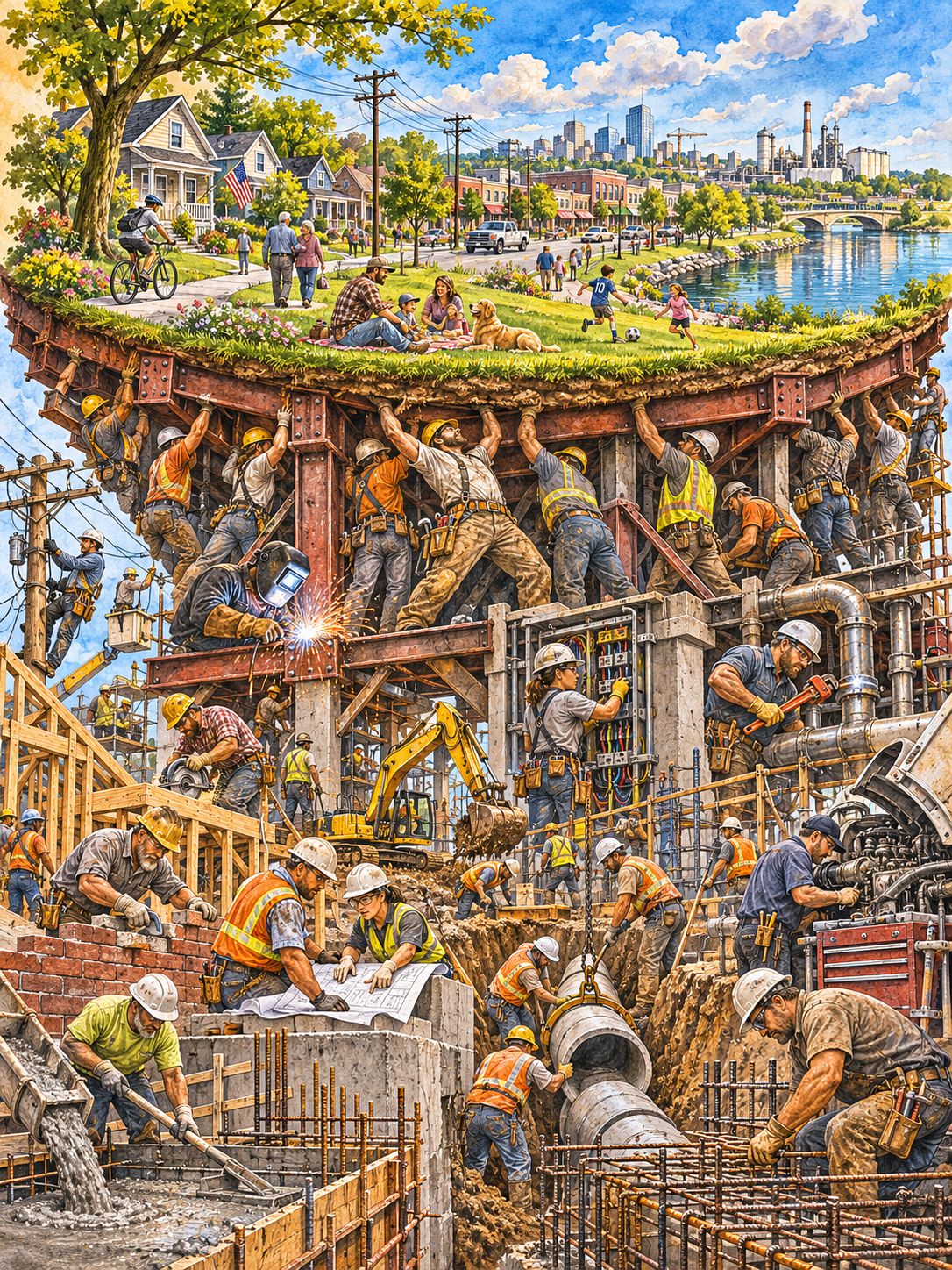
Infrastructure Foundations
*
‘Nice to haves like parks are built on the foundations of critical infrastructure. The foundations of civilization are structural, hidden, out of sight, and out of mind. It would do us well to take a little time out to remember that.’ —Sky Huddleston, Eternal Engines
*
 
V
Sky Huddleston’s Eternal Engines, a foundation of and for critical infrastructure
*
‘xxx’
*
 
*
An introduction to Garet Garrett by Jeffrey Tucker, Brownstone Institute, “The Brilliant but Neglected Novels of Garet Garrett” •••
*
 
V
If AI is to end humanity, then …
*
The conclusion of Beethoven’s Ninth is a monumental expressions of joy, and perhaps of defiance. But that glory ends, and the musicians go home. If AI should extinguish us, we might resolve to depart in that way. Some say Beethoven died with a fist raised to a storm. It may be so for the entire human race.
*
“To strive, to seek, to find, and not to yield.” —the last line of “Ulysses”, by Tennyson
*
 
V
AI — Clay, Wheel, Creator (agent)
V
AI holds all the public inscriptions of humanity, ground fine, spun together, held as if in a mass of clay by attractions weighted by frequency of proximity. From that mass a creator gathers a sample and places it on the wheel. Then under the artist’s hands something new takes shape.
V
See the blending of Tennyson’s “Ulysses” and my “Freeorder Bridge 0.95” made by Perplexity.ai in the September 2026 “Threads”
*
“Ulysses” ••• [poetry foundation] by Alfred Tennyson
*
“Freeorder Bridge 0.95” ••• by Leif Smith
*
“A Bridge for Ulysses” ••• blended by Perplexity.ai
*
 
V
Michael Strong recommends: What will be scarce? x.com The economics of structural change and the post-commodity future of work, by Alex Imas x.com 15 Apr 2026
*
The Ghosts of Electricity ••• the substack of Alex Imas
*
Alex Imas writes ••• ‘I joined Google Deepmind to develop a research program on the economics of AGI. Together with Andrew Koh and Shane Legg, we are incredibly excited to release The Economics of Intelligence, the first in a series of projects from our group on how AGI will change the economy.
How do capability improvements transform the economy, and when? In this project, we define thresholds of economic capabilities, e.g., minimal AGI, based on how they transform the economy. We then track how the economy–market structure, employment, and wages–changes during the transition across capability regimes.’
*
 
V
An Historical Note (imaginary) on the Emergence of Freeorder
*
The Emergence of Freeorder was driven by multi-phase polycentric asynchronous collaboration of many ∮forge within ∰forge. The Emergence was made by active purposeful uncoordinated fragments, none capable of achieving the objective, but, together, finally doing so in a way that appeared, in retrospect, to have required design. But, although without design, similar images of Freeorder had been born in mind, and at last macro-Freeorder emerged out of a multitude of micro-Freeorders.
*
 
V
Joyce Brand, Free Cities: two articles
V
“Individualism vs. Collectivism ••• The Forgotten Path to True Community”
*
‘For most of my life, I assumed the real conflict in political philosophy was between individualism and collectivism. It’s the frame we’re all handed: one side cares about the individual; the other cares about the group. Choose your camp.
But the more I studied governance — and especially after learning from Spencer Heath and his grandson Spencer MacCallum — I realized that this entire debate rests on a false premise.
The opposite of collectivism isn’t individualism. It’s communitarianism — the voluntary creation of community through relationships, exchange, alignment, and consent.’
*
The exchange between Philip Bodeswell author of The Narcissist State ••• and Joyce in the comments to this article is excellent. -ls
V
“What Two Snakes Reveal About Governance” ••• balancing rules & judgement
*
‘… a problem every system of governance must solve: How much discretion should administrators have when the rules don’t provide a clear answer?’
*
 
V
The Sovereign Network: How Network Autonomy Builds Durable Community
*
Forthcoming book mapping the structural conditions for networks of voluntary, contractual jurisdictions.
*
 
V
Self-Sovereign Identity (SSI) contrasted with other forms of Digital ID [Brandon]
*
Agata Slater
*
 
V
Dana Rohrabacher’s work on the U.S. Patent System, the America Invents Act, 2011
V
Hot Property: The Stealing of Ideas in an Age of Globalization by Pat Choate
*
 
V
A Starship (flight 15, 13-14 Nov 2026), after entering orbit and deploying 26 Starlink satellites, returns to Starbase, Texas, where it is caught ••• (watch) by Mechzilla.
*
 
V
Andrew Roberts on Napoleon, interviewed by Triggernometry
*
 
V
Regs Equals Collusion, Joel Salatin, The Lunatic Farmer
*
 
V
A Turning Point in the story of America?
*
‘The Year We Stopped Playing Defense x.com We want to tell you what you made possible this year, what we intend to do next, and why we are asking for your help now in a way we have not before.’
*
 
V
Shannon Ewing: Imagining a world with one GPU for each person •••
*
‘A few weeks ago, I tried my hand at something new: a sort of fictional essay as submission for the challenge of GPU World, the prompt was what if the world had one GPU per person?’
*
There will be more of this: ‘Less terror, more wonder: a stranger’s first snowfall, a recipe passed across an ocean, a joke in Tamil that landed in Tehran. The world arrived as it was lived, from the people out to the people.’
*
 
V
Palmer Luckey: interviews (out of dozens)
*
Walter Isaacson (biographer of Jobs & Musk) •••
*
Peter Robinson, Hoover Institution: “Palmer Luckey Wants America to Win” •••
*
Mike Rowe: “Palmer Luckey Will Change How You Think About War” •••
*
 
V
HOL Guard ••• Your AI can make mistakes. Stop the dangerous ones.
V
A review ••• of HOL Guard by AiMiracle ••• – your daily hub for AI news, insights, and breakthroughs.
*
‘AI coding agents write code, edit files and run terminal commands in seconds. That speed is the whole point of Claude Code. It also raises one simple question: who checks the command before it runs? HOL Guard answers it with a checkpoint between your agent and your computer, and this HOL Guard review puts that checkpoint to a real test.’ —AI Miracle Mag
*
 
*
.oOo.